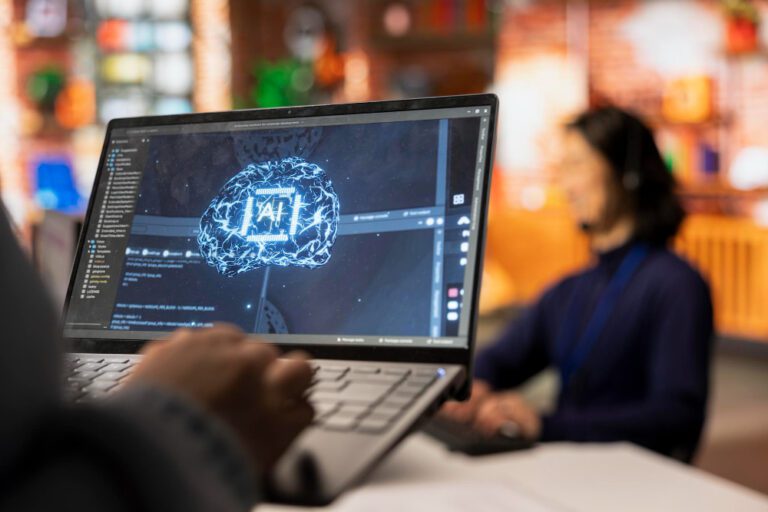
When ChatGPT was launched earlier this year, it took the world by storm! Everyone’s eyes were suddenly opened to the possibilities of AI, and it seemed a plethora of exciting and incredible new website AI tools hit the market seemingly overnight.
However, along with the excitement and intrigue that came with these new AI tools, there was also an element of fear and uncertainty. How would these tools slot in to our daily lives? Would they replace us? Would we all be out of a job within a couple of years?
Given the rapid advancements and seemingly human-like intelligence some of these tools provide, these questions certainly aren’t unwarranted.
Where are we at now?
It’s been roughly 6 months since we started experimenting with AI here at Red Giraffe, and it’s certainly become an integral part of our daily lives. We now have AI directly implemented into our custom web design software, which allows us to generate images, write headlines, create copy, produce HTML & CSS code, and write meta descriptions.
We use it for help with SEO, such as assisting with keyword research, suggesting blog post titles and topics, and rephrasing copy across a client’s website where we want to avoid duplicate content from one page to another.
And it’s proving an excellent customer service tool, helping to write email content to accompany proposals, answer queries, and calmly respond to any client concerns.
Will it replace us?
My strong belief having used AI to assist our website design processes for the last 6 months is an overwhelming NO – AI will not replace us! It will almost certainly become an invaluable tool in our belt, in the same way that spellcheck has helped copywriters, CAD has helped architects, Photoshop has helped photographers, and visual builders have helped web designers.
AI is dependant on precise prompting, and the thing is, so often clients just don’t know exactly what they want – making accurate prompting very difficult. It often takes us several hours of in-person discussions followed by several iterations of a design before we can really achieve an end product in-line with the client’s vision, especially as not all clients are fully clear on what they want or need when they first discuss their web design needs with us.
From what I have seen, AI cannot be a thought leader. It can easily mimic and replicate, which in some instances is fine. But if someone comes to us and says “I want a website for my business that is nothing like anyone in my industry has ever done before” then AI will struggle. I asked ChatGPT to write “Three unique USPs for my web design agency in Milton Keynes” and it suggested “Quality, customer service and experience” – USPs that are hardly unique or stand-out.
AI can digest existing content and write articles based on what it has read and understood. But it cannot give an opinion or forecast predictions based on instincts, in the way I have in this article.
AI is also trained on existing data; whilst it is likely this data will be updated periodically, it is unlikely AI will be able to keep up with current affairs. For example, if a breaking news article comes out in the morning, a human copywriter can publish a blog post that afternoon on how this is likely to impact things and what we can do to minimise impact. An AI copywriter would not have a knowledge of that news article or how it will impact things for some time.
Likewise with SEO; if Google publish a new guideline or algorithm update, human SEO practitioners can instantly respond and make rapid changes to their websites inline with the updates. AI SEO software would take a while to catchup, by which time the damage may have been done.
Conclusion
For some use cases, AI is perfect. For example if you’re a landscape gardening company and you want to publish regular, ever-green content, such as “10 top tips to keep your lawn looking fresh this summer” then AI is a fantastic tool. AI will become an integral part of our daily lives and a tool many of us use to help with repetitive and mundane tasks.
However, if you want to be a thought leader in your industry and publish articles such as “our thoughts on how AI is influencing Milton Keynes web design agency,” or you want to discuss highly relevant topics taking place in real-time then human input will always be needed.
I believe it is human nature to want to interact with other humans, and ultimately people will want to do business with people over machines. Human beings are strange and amazing creatures who sometimes know what they want without really having a clue what they want, and only another human can interpret the brief and read between the lines.
For me, AI is like a Satnav. If you know your exact destination and you want to get there as quickly as possible, it’s perfect. If you know roughly where you want to end up, but want a journey filled with stunning sights, culture and adventure tailored to your exact requirements – then you need a guide; a human guide who can read between the lines and make suggestions such as “yes, you can drive there in 8 hours, but why not split the drive into two so you’re not exhausted, and take a slight detour to this cute little fishing village? I know a great restaurant there where the food is exquisite!”